SOS, and what it will not do.
Kolvoy's SOS tells your group and your emergency contacts where you are. It is not a substitute for emergency services. If someone is hurt, call your local emergency number first.
How SOS works
- Hold the SOS button for one second. It is a hold, not a tap, so a glove brushing the screen cannot trigger it.
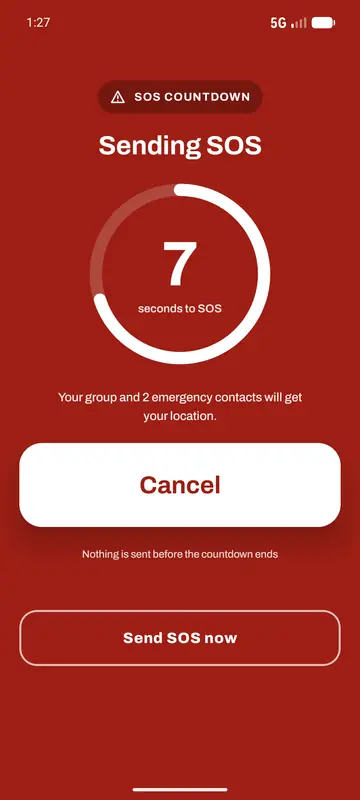
- A 10-second countdown starts. You can cancel it. Nothing is sent before it ends.
- Your group is alerted with your location, over the mesh and the internet at the same time. Each phone that hears it passes it on.
- Your emergency contacts get a text with your location and a map link as soon as any rider in the group has signal. It does not have to be you. Their numbers are kept encrypted on our server, so the other riders never see them.
- Riders answer. You see who received it and who is coming.
The limits, plainly
- No crash detection. Kolvoy does not sense a fall or an impact. SOS is always started by a person: you, or a rider who sees you need help.
- Not an emergency service. Kolvoy does not contact police, ambulance or rescue. The SOS screen has a button that dials your local emergency number.
- Texts need one rider with signal. If nobody in the group has cellular coverage, contacts are texted when someone gets it back. If a text cannot go out, Kolvoy offers to open your own messaging app with the SOS text ready.
- The alert needs a path. A rider out of range of every other phone, with no signal, cannot send or receive it until they are back in range.
- Location is as good as GPS. In canyons and tunnels the position can be off or stale. The alert shows its accuracy.
Riding with Kolvoy
- Set it up parked. Pair, join and check audio before you move.
- Hands on the bars. Do not look at or touch the phone while riding. Hands-free mode exists so you never need to.
- Keep the volume sane. You need to hear traffic, sirens and your engine.
- Know your local law. Rules on helmet speakers and communication devices differ by country and state.